This researcher and entrepreneur builds assistive robots to help people live more independently
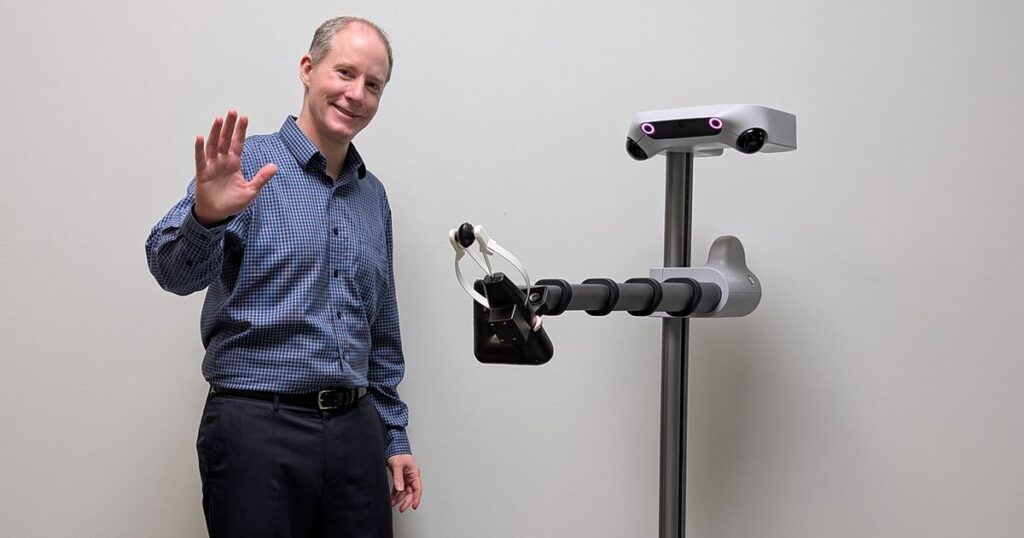
In this edition of our A Day in the Life of a Roboticist series, we meetCharlie Kemp, cofounder and chief technology officer ofHello Robot, who develops mobile manipulators to help people in their homes and workplaces. His interest in robotics began with the grand challenges of artificial intelligence, and his work has taken him from humanoid robots at MIT to assistive robots for older adults and people with disabilities. “Working at Hello Robot …
My focus is on enabling mobile robots with arms to benefit people in homes and workplaces. Many promising applications for robots involve close physical interaction between people and robots, such as robots that physically assist older adults and people with disabilities.Â
Working at Hello Robot is a rewarding experience. I love the community using Stretch robots as research and development platforms. They’re discovering new ways that human-friendly robots can benefit society. I also love Hello Robot’s collaborative efforts to create assistive robots for older adults and people with severe mobility impairments. Finding human assistance is becoming more difficult due in part to aging societies. Robots have the poten…
Some of the best days are focused on the people using the robot rather than the robot itself.Keith,Henry and Jane Evans, and hundreds of people who have worked with robots from Hello Robot and my academic lab have changed my perspective on robotics and life in general. What is actually important in people’s lives? Sometimes, scratching an itch or picking up a dropped object is what’s important. What are the real challenges for creating a useful a…
Robotics initially attracted me as an approach to tackling the grand challenges of artificial intelligence. I became interested in AI as an undergraduate at MIT.Prof. Rod Brookshad just started theCogproject, a highly ambitious and exciting research effort to use humanoid robots to investigate embodied intelligence. I was hooked! I eventually joined Rod Brooks’s lab and worked on the humanoid robot Domo with my cofounder Dr.Aaron Edsinger. Aaron …
One of the most rewarding aspects of robotics is seeing software come to life in the physical world. There’s a unique satisfaction in writing code that leads to a robot doing something new. The field is still young, so you can see glimpses of the future. More importantly, you have the opportunity to influence the future. I used to imagine there was an inevitable path for technological progress, but I’ve come to realize that many futures are possi…
There are two things I’d emphasize. First, it’s easy to watch videos of robots online and feel like robotics has been solved. But the truth is that there is a vast difference between a demo video and a robot being productive in the real world. The world is more creative than we are. It’s extraordinarily good at breaking robotic systems in ways that surprise roboticists. There is still an enormous amount to build, learn, and discover. For anyone s…
Second, you don’t have to focus on robotics technology to work in robotics. The most impactful applications of future robots will likely depend on robotics technologists working together with people with expertise in specific application areas. For example, Dr.Vy Nguyá» nis the clinical research lead at Hello Robot. She started in robotics while earning her doctorate in occupational therapy. Her expertise in occupational therapy has helped her ma…
I’ve been fortunate to work on a variety of exciting robotics projects with teams of remarkable people. It’s hard to pick one, but Robots for Humanity stands out.Â
Back in 2010, Henry Evans sawa demonstration of my academic lab’s research on CNN. This led to a collaboration that continues to this day as part of Henry’sRobots for Humanityeffort. Henry has severe quadriplegia, and he and Jane Evans are inspirational pioneers in assistive robotics. In collaboration with Henry, Jane, and others, my former lab at Georgia Tech (theHealthcare Robotics Lab) made progress toward mobile robots with arms (mobile manip…
Creating a home robot for Henry and Jane was the main inspiration for the prototype robot my lab created that led Aaron and me to found Hello Robot. And the research my lab conducted as part of Robots for Humanity continues to influence Hello Robot’s work on an assistive home robot. Henry and Jane have used each generation of Stretch, which has influenced the subsequent designs, especially Stretch 4.
Robotics is full of surprises! It’s fun and humbling. My academic lab focused on physical robotic assistance for tasks such as feeding, hygiene, and dressing. At Hello Robot, I’ve been surprised by the ways physical robotic assistance canhelp people connect emotionally.Â
For example, Henry Evans used Stretch to present a rose to Jane. Picking up the rose and handing it to Jane involved relatively simple robotic motions, but the result was an emotionally powerful gesture.