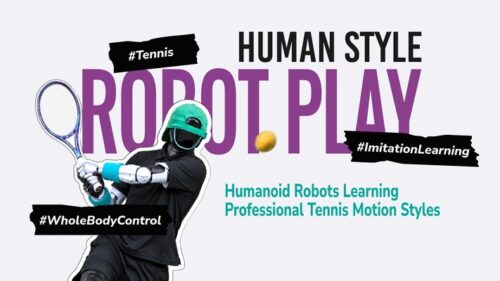
This White Paper provides roboticists and control engineers with a comprehensive overview of how motion planning and motion tracking can be decoupled to preserve professional athletic style in humanoid robots, and why adaptive, speed-aware control is essential for closing the gap between simulation and real-world deployment.
Why combining a professional athlete’s motion style with reliable task performance remains an open challenge in humanoid ball-sports robotics, and how separating a high-level planner from a low-level tracker addresses this trade-off.
How motion data extracted from broadcast video and motion-capture recordings can be reconstructed, retargeted, and physically corrected into reference motions a humanoid robot can safely track.
Why the sim-to-real transition introduces compounding tracking errors, and how training a tracker on randomized execution speeds, paired with a learned motion-speed adapter in the planner, improves robustness on physical hardware.
How this adaptive framework was validated across two humanoid platforms, including full-size, in-the-wild serving performed without any motion-capture system.
and Wiley are proud to bring you this White Paper, sponsored by Noitom Robotics
Humanoid robots have begun to show real capability in ball sports, but preserving a professional athlete’s motion style while maintaining reliable task performance is still an unresolved problem. This guide examines an adaptive motion planning and tracking framework that learns tennis serving and rally styles directly from broadcast video and motion-capture data. A hierarchical design separates a planner, which generates stylistic kinematic motio…
First register your details to create a user profile for the hub, then login to access all content within the hub.
Noitom Robotics builds ModalityNet, the human-centric data substrate that makes the physical world learnable for embodied AI.
IEEE Spectrum Magazine, the flagship publication of the IEEE, explores the development, applications and implications of new technologies. It anticipates trends in engineering, science, and technology, and provides a forum for understanding, discussion and leadership in these areas.
HiPHI: A Large-Scale Benchmark for High-Precision Human Motion and Object Interaction
1. Same tier 3 topics + same sponsor [1], 2. Same tier 2 topics + same sponsor [1], 3. Any topic + same sponsor [1], 2. Same tags + same sponsor [1], 3. Same sponsor [1],
Fast RF Device Testing with Analog Sources: A Practical Guide to Amplifier and Receiver Characterization
Edge AI for Smart Cities: From Real-Time Insights to Cognitive Urban Systems
HiPHI: A Large-Scale Benchmark for High-Precision Human Motion and Object Interaction