Industry has drained the stateâs water reserves for decades. Data centers are the breaking point.
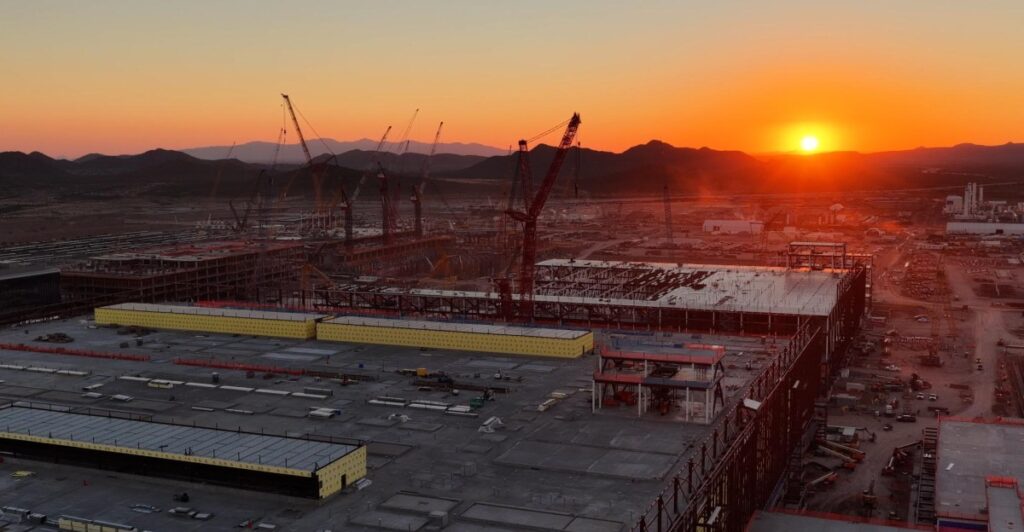
AAhulking gray giant rises from the desert. Inside, engineers create the force behind our phones and computers and appliances, our streaming services and search engines and chatbots and vibe-coded apps and websites. The complex is simultaneously massive and squat, dwarfed by the mountains that surround it, and it is endless. I drive past one building, and then another, and then the ground opens up where construction crews have dug up the earth so…
I stand before the savior of Arizonaâs economy. Like all great deities, it demands sacrifice. In the desert, nothing is more precious than water, and water is what must be given â nearly 5 million gallons a day, every day, sourced from Phoenixâs municipal supply. The offering has been well worth it.
All of this is the fruit of the Taiwan Semiconductor Manufacturing Company, the worldâs leading producer of microchips. Its Arizona operation is the result of a pre-pandemic gamble Phoenix made torevive its sluggish economy, which never quite rebounded from the Great Recession. Now TSMCâs foundry looms over the cityâs outskirts.
TSMC is a success story, one that some local leaders may have hoped to repeat with hyperscale data center developments. The progression may have seemed natural: The Grand Canyon State is not only home to the largest chip factory this side of the Pacific but also172 data centers, neither of which faced much pushback. But the newer, larger developments being proposed from Phoenix to Tucson demand more of everything â more water, more power, more …
In reporting this story, I spoke to local activists and economic developers, elected officials and their angry constituents. I sat in on city council meetings where people lined up by the dozens to speak up against data center projects, and in cozy suburban homes where tight-knit groups of former strangers told me about the struggle that brought them together. I pored over maps of Arizonaâs dry, cracked landscape with laypeople who, over the pa…
In Arizona and elsewhere, data center developers have tried to win over locals by making enticing promises about the jobs, tax revenue, and infrastructure theyâll bring with them. All they ask for in exchange is water â and, they swear, not nearly as much of it as youâd expect. Some hyperscale data centers, like Googleâs facility in The Dalles, Oregon, use about 1.5 million gallons a day, about one-third of what TSMCâs Arizona complex c…
Even now, as people across the country sour on AI and fight against data centers in their communities, TSMCâs Arizona operation hums along without significant opposition. And yet itâs impossible to make sense of why Arizonans are so opposed to new data center development without first understanding why they eagerly welcomed TSMC, even though both industries must contend with the issue that has plagued Arizona since its founding: There isnât…
For as long as anyone could remember, business in Arizona revolved around the storied âfive Câsâ: cattle, copper, cotton, citrus, and climate, a catchall for the regionâs mild, salubrious winters, which locals say often more than make up for the sweltering summers.
Now the state has a sixth C, Arizona native Christine Mackay tells me. âChips.â
The TSMC development is, in a sense, Mackayâs doing. As the head of Phoenixâs economic development office, she spearheaded the effort that brought the Taiwanese giant to the Sonoran Desert. In 2020, while the global economy was all but shut down, TSMC made an announcement. The same forces that brought the world to a standstill had created even more demand for TSMCâs products, and in response, TSMC would be opening an advanced semiconductor …
TSMC just put the finishing touches on its second fab in a formerly desolate swath of north Phoenix, with a third under construction and plans for several more underway. This buildout has been more than a decade in the making. TSMC started shopping around for a US location in 2016. That year, Mackay said, the company put out a request for proposals through a codename. No one won.
âWe arenât a group that takes no for an answer,â Mackay said proudly. Her office asked TSMC executives what they thought Arizona was missing, and then spent the next three years addressing their concerns. In 2019, Phoenix sent a delegation to Taiwan to share a new development plan for a science and technology park, the nucleus of which would be a factory, ideally one of TSMCâs fabs. âThey agreed they needed to come back and take another…
What followed was a flurry of development unlike anything the state has ever seen. TSMC has brought more than 3,500 jobs to the state, and an entire economy has sprung up to support the companyâs Arizona operation. Much like in Taiwan â where the company accounts for nearly one-tenth of Taiwanâs gross domestic product â TSMC has become, if not the center of the universe, then at least a galaxy unto itself. The company controlsan estimated…
TSMC has changed swaths of Phoenix â its landscape, its industries â and it has brought with it jobs and prosperity. Locals fear that the new hyperscale data center developments will do the former but not the latter, consuming resources while contributing little to the community. Mackay, who has worked as an economic developer for over 30 years, didnât experience significant pushback when she helped court data center developments in the pas…
The new developments being proposed are neither pretty nor little. Where earlier data centers were inconspicuous, the hyperscale facilities developers want to build in Arizona â often on rural farm or desert land â are both massive and incongruous. Despite the stateâs recently acquired reputation for sprawl, there are still plenty of places where, in the quiet desert stillness, you can sometimes hear a pack of coyotes howl in the middle of …
Year-round but especially in the summers, Arizonans tailor their routines to the elements. Drivers are careful not to get stuck in dust storms or monsoons. Joggers avoid going out in late mornings and early afternoons, when the heat is at its most intense. And on August 1st, at the peak of monsoon season, the No Desert Data Center Coalitionâs protest began in the early evening, when the sunâs punishing rays were starting to give way to a mute…
About a dozen people showed up to the rally on the outskirts of Tucson, in front of the 290-acre site where Beale Infrastructure is building a 600-megawatt data center. Every few minutes, Vivek Bharathan, one of the organizers, reminded the protesters to stay hydrated. Children sprayed each other with water guns and dutifully accepted drinks from their parents. Mayra Duron, one of the attendees, brought a cooler of agua de jamaica to share with t…
âIf you feel the heat, please head home,â Bharathan told the small crowd. âIt is a hot day, and if they succeed in building a data center here, itâll be even hotter. We know these thingscreate heat islandsthat can affect the surrounding area by over 10 degrees Fahrenheit.â Duron, a local macrame artist who incorporates cactus spines into her weaving, said she worried about how rising temperatures would affect the regionâs saguaros. â…
Cars honked in support. Some drivers pumped their fists out their windows as they sped by. Arizonans werenât riled up about AI in 2019, when the TSMC project was announced, nor did they notice or care much about the previous data centers that were quietly built throughout the state. Things have changed. Tucson, it appears, is united in its opposition to the data center complex dubbed Project Blue. But the buildings are going up anyway.
Information about Project Blue began slowly trickling out in the spring of 2025. First came the name, andsome clues: The development, whatever it was, would be on a county-owned plot of land; it would create 3,000 temporary construction jobs and 200 well-paying positions down the road; it would generate $152 million in tax revenue over the next decade; it would be big, and it would be thirsty, and new water lines would be built to keep it satiate…
The news came out in a mundane, bureaucratic way, as information about prospective land sales in midsize cities often does. In June 2025, Jan Lesher, the Pima County administrator, submitted a 44-pagememoto the Board of Supervisors. The words âdata centerâ did not appear until the fourth page. This data center would provide an âunprecedentedâ $3.6 billion opportunity for Tucson and for the county. There were other details, and there was f…
âThe boost it could provide to our local economy may well be transformative,â Rex Scott, one of five members of the County Board of Supervisors,said at the time. His colleagues were split. They voted 3-2 to rezone the 290-acre tract, and voted again to sell it to Beale for around $20 million. But it wasnât a guarantee yet. One of the terms of the deal required Tucson to annex the land and approve the sale, since the city would be on the hoo…
The honeymoon, if there even was one, didnât last. Just hours after the boardâs vote, Tucson Electric Powerannouncedit was looking into a rate hike that would increase customersâ bills by an average of 14 percent. The utility claimed the decision was unrelated to the forthcoming data center. Even still, one of the commissioners who voted to rezone the land and sell it to Beale officially asked to reconsider the rezoning.
Perhaps it was the fact that Tucsonans learned of the data center and the rate hike in such quick succession, coupled with the inescapable news ofdata centers raising localsâ utility bills, that catalyzed their mass opposition. Maybe it wastheArizona Mirrorâs reportthat Project Blue, combined with another proposed data center, would not only be TEPâs biggest customer but also consume more than four golf coursesâ worth of water each year. …
Around 200 people showed up to a public information meeting Bealehostedin the auditorium of a local high school in July 2025. Most of them were furious about the data center, or they were worried, or they were scared. Tensions wereeven higherat the follow-up meeting held at the Tucson Convention Center. Over a thousand people showed up. The boos started before Bealeâs representatives got through their introductions, and they continued throughou…
Keri Silvyn, one of the attorneys representing Beale, tried to warm up the crowd. âWe all have cellphones, we have computers, a number of us have multiple of those in our households,â she said. âMany of the various signs that Iâve seen have QR codes, that if you click on, will take you through a data center in order to get to different sites. The internet is housed in data centers. Thatâs what they are.â Bealeâs team explained that …
To no oneâs surprise, the opposition mostly came down to water. Locals worried that if the data center came to town, the resource, already so scarce and so precious, would vanish. They cited the fact that Arizona would likely lose more of its Colorado River allotment. They conjured images of even hotter, drier summers.
When it was her turn to speak, Melanie Cooley, an education specialist at the Watershed Management Group, a local habitat restoration nonprofit, conjured up a past familiar to few Tucsonans. âWhere we are sitting right now was a forest 125 years ago that adjoined a flowing river that flowed year-round,â she said. âThere are people alive today who grew up swimming in the Santa Cruz River.â
Average temperatures in Tucson are now 11 degrees Fahrenheit higher than they were a century ago, Cooley said. About six degrees of that rise can be attributed to global warming. The other five, Cooley explained, are because of changes in the local ecosystem, including the felling of forests and the drying up of rivers like the Santa Cruz. âWhat we see today when we drive across that river that looks like a big, dry ditch, we take it as normal …
Another speaker compared Project Blue to industrial projects of decades past. âThis is like déjà vu for me,â he said, listing off economic development projects that were supposed to turn things around for the city: Raytheon; Hughes, the military contractor that preceded it; the Air National Guard. âWhat did they do? They contaminated our water. To this day, weâre having to deal with that.â Tucsonans had gone to great lengths to conser…
Two days after this contentious hearing, a unanimous vote by the Tucson City Council shut down the annexation of the land. At a subsequent meeting, the city adopted new rules for data centers and other large water users. Residents were relieved, but not for long. Three weeks after the city stopped the annexation, effectively killing the development,local reporters confirmedthat Beale was moving forward with the data center anyway. County official…
Over time, there were other adjustments to the plan: The data center would no longer be water-cooled and would instead rely on closed-loop air cooling. If the shift was intended to win over Bealeâs critics, it didnât work. Members of the No Desert Data Center Coalition claim that air-cooled facilities use more electricity, and, since power plants also use water to cool their systems, air-cooled data centers may actually be more water-intensiv…
Still, the project moved forward. The county completed its deal with Beale on Christmas Eve, and Beale promised to bring even more gifts in the form of $15 million in donations, some of which would go toward local STEM and trade school programs. The new year brought more challenges. The stateâs attorney general filed an appeal againstthe Arizona Corporation Commission, the state agency that oversees public utilities, over its approval of a spec…
The coalitionâs suit got tossed, but the data centerâs opponents found other ways to voice their displeasure. Theystaged a protestinside the offices of Lazarus and Silvyn, the law firm representing Beale in its dealings with the county. When construction crewsbroke groundon the site, dozens of people were there, blocking vehicles while chanting, âWe respect the workers, we donât respect the work.â The data centerâs opponents havenât…
None of this grassroots opposition, however, has been enough to actually stop Project Blue. To facilitate construction, the Arizona Department of Waterapproved a requestto build two wells on the site, allowing the facility to draw up 31 million gallons of groundwater a year. Burkart said this water will only be used for construction. Once the data center is up and running, Burkart said, water use âwill be limited to ordinary domestic purposes, …
Some local leaders have since worked to regain the communityâs trust. After a contentious meeting in August, the Tucson City Council implementednew, stringent limits on data centers, making them one of the most regulated developments in the city. But residents want more, and theyâve vowed to keep showing up until they get a full ban. Even the county government has been surprisingly amenable of late. In September, the Pima County Board of Supe…
Rebecca Chen understood the promise of TSMC well before most other Arizonans. A Phoenix resident since 2015, she started working as a Realtor in 2019, just before the company arrived. âTSMC may not be a huge household name for a lot of Americans, but it is for Asians,â Chen said. âTSMC is basically like Apple or Tesla for Taiwanese.â The covid-19 pandemic sent the industry into a frenzy: Americans, largely confined to their homes, wanted …
âI feel like Iâm way more than a Realtor,â Chen told me. âIâm like a guide to them.â Sheâs helped clients set up utility bills, get their driverâs licenses, recommended places to eat and shop. âIâm an immigrant myself,â she explained, so she knows how hard it can be to feel settled in a new place. Arizonaâs Taiwanese immigrants have risked a lot in coming to America, staking their futures on a new project in an unknown pla…
TSMCâs presence in Arizona has revived a way of life some thought had vanished in America: a prosperous household where one partner (usually male) works at a factory and earns enough to support a family. Think of it as the midcentury ideal with a new global twist, suburban idyll propped up by industrial manufacturing. TSMC now has more than 3,500 employees in Arizona, according to spokesperson William Moss, who said the company doesnât disclo…
New businesses have popped up to cater to Arizonaâs growing Taiwanese community, further bolstering the local economy. North Phoenix now has aLittle Taipei. Restaurants have opened to cater to these new Arizonans, some opened by the newcomers themselves. Buildings have popped up seemingly overnight to house them. Mandarin-speaking real estate agents like Chen have found a lucrative niche selling luxe new-build homes to well-compensated tech wor…
Some of these changes happened organically; others resulted from meticulous planning. Mackay, the economic developer, told me that the local grocery chain Fryâs reached out to her office to ask what products Taiwanese customers might want to see on its shelves. Mackay set up a meeting between Fryâs and TSMC, and she set up another with a Taiwanese attorney who worked with the state Department of Transportation to ensure Taiwanese immigrantsâ…
Phoenix and Taipei have been sister cities since 1979, a designation that, until recently, was largely ceremonial. As is the case in all sororal relationships, there have been conflicts, some of them over shared resources. Given the industryâs demands and the stateâs historic drought, critics ask, is it wise to build water-guzzling factories in the middle of the desert?
TSMC hasnât faced nearly as much pushback for its water use as data centers have, but semiconductor manufacturing nonetheless requires massive amounts of water, and this water must be of a specific grade â free of contaminants organic or otherwise, and so devoid of minerals that itâs actually not recommended for human consumption. It takes1.4 to 1.6 gallonsof municipal water to create a single gallon of ultrapure water, since some is inevit…
Each chip requires 50 to 250 wash cycles, Paul Westerhoff, the director of ASUâs Global Center for Water Technology, told me. âIf thereâs a little particle in there, or an ion-like chloride in there, the thing doesnât work,â Westerhoff said, âso they need to use a lot of water in each of these cleaning cycles.â This processrequires 4.75 million gallonsof water each day, which TSMC obtains through Phoenixâs municipal water supply.T…
Westerhoff compared the process of semiconductor manufacturing to washing dishes. And just like you wouldnât reuse your sink water to wash a second round of pots and pans, chip manufacturers canât reuse their dirty water to wash other chips. But this water isnât totally lost. âIf you want to reuse sink water, maybe you throw it out on your lawn,â Westerhoff said. He explained that TSMC uses 20 percent or so of its recycled water to powe…
Sarah Porter, the director of ASUâs Kyl Center for Water Policy, explained that while 15 to 20 percent of the water TSMC uses is lost to evaporation, much of the rest is processed in the companyâs recycling plant. According to Porter, TSMC recycles 60 to 65 percent of the water that flows through its first Arizona fab and is planning for 90 percent reuse by 2028. To get there, TSMC is building an on-site reclamation facility. The ultimate goa…
The fact that TSMC can recycle most of the water it consumes differentiates it from some of the stateâs traditional industries. And even if TSMC were to someday use more water than some of Arizonaâs more conventional enterprises, the regionâs leaders say the tradeoff would be well worth it. âWe call it the economic value of a gallon of water,â Mackay told me. âThat gallon of water can do a huge amount for the region, or it can do noth…
TSMC brought with it an entire industry. So far, 55 TSMC suppliers have set up shop in Arizona, as per Mackay, and more are on their way. Topco Scientific, a Taiwanese materials integrator that works closely with TSMC, opened an outpost in Phoenix in 2022, operating at a loss for years until TSMCâs first fab was up and running. Chang Chun, a Taiwanese petrochemical firm, now manufactures electronic-grade hydrogen peroxide in Casa Grande, a city…
The TSMC complex uses more water in nine days than Project Blue is expected to consume in a year, but TSMC has also boosted the state economy in a way no data center could. Data center developers used to pitch the projects to local governments by emphasizing the fact that they donât create many permanent jobs; communities would get infrastructure and tax revenue but none of the congestion that comes with rapid population growth. But now, after …
âWhen weâre talking about semiconductor manufacturing, thatâs very different from, say, a golf course,â Porter said. Arizonaâs golf courses, in fact, have historically used far more water than the state allows, much of it sourced from the rapidly drying Colorado River. AninvestigationbyThe Arizona Republicfound that the stateâs golf courses consumed nearly 39 billion gallons each year between 2002 and 2022. âThat water,â Porter ad…
But critics of semiconductor manufacturing say that the amount of water the industry uses is just part of the problem. âThereâs water quality, and thereâs water quantity â or water use and water contamination,â Judith Barish, the coalition director of CHIPS Communities United, told me. The coalition, made up largely of labor and environmental groups, was founded in the wake of the CHIPS and Science Act, which designated $52.7 billion in…
Semiconductor manufacturing involves the use of hundreds of different per- and polyfluoroalkyl substances, or PFAS, which are commonly referred to as forever chemicals because they donât naturally break down. The durability of these chemicals means they wonât be degraded during the manufacturing process, which can involve hundreds or even thousands of steps. But the qualities that make PFAS so essential to chipmaking are precisely what make t…
Some researchers have linked chip manufacturing to thyroid and liver diseases, fertility problems, and cancer â an especially ironic outcome, givenAI boostersâ claimsthat the technology will cure cancer within our lifetimes. Women who worked in chip fabs during the â80s manufacturing heyday weretwice as likelyto suffer miscarriages than women who didnât, and their children were also more likely to experience birth defects. And because eac…
Traditional wastewater treatment methods often fail to detect forever chemicals, and most semiconductor manufacturersarenât requiredto monitor or test for PFAS. Compounding the problem, the exact chemical cocktails used in chip fabs are closely guarded trade secrets. But TSMCsaysit has âcontinuously optimizedâ its in-house PFAS detection systems and is developing technologies to remove PFAS from its wastewater streams. The company also says…
Still, for organizers like Barish, wastewater disposal remains a concern. While TSMC and other chip manufacturers have to comply with city and EPA standards, Donald Trump haslargely defanged theEPA andeased restrictions on PFAS in drinking watersince returning to office. But concessions for chip manufacturers have been largely bipartisan. The Building Chips in America Act â sponsored by Sen. Mark Kelly (D-AZ) and signed into law by President Jo…
Arizonans have gone to great lengths to reduce their water consumption and to roll back the industrial pollution that has tainted groundwater in Tucson and surrounding communities for decades. Still, experts say the mess caused by PFAScould take generations to clean up. And as the stateâs economy becomes increasingly tied to tech â which not only uses huge amounts of water but also produces industrial waste â some residents fear an even mor…
Arizonaâs historic megadrought was set in motion well before any part of the tech industry gained a foothold in the Grand Canyon State. Itâs an almost cartoonishly simple issue of supply and demand, one whose consequences are complex and still uncertain. Hotter and drier summers in the Rocky Mountains are drying up the Colorado River, the source of more than one-third of Arizonaâs water. At the same time, Arizonaâs aquifers are being drai…
The 1922 Colorado River Compact â the agreement that determines how much of the riverâs water to allocate to seven states â simultaneously overestimated the long-term supply of water and underestimated the demand. Legislators in 1922 could not have foreseen the midcentury population boom or the severity of climate change. But this alone does not explain Arizonaâs current water woes. Thereâs also the matter of Arizonaâs dwindling aquif…
Over the past decade, one commodity crop, increasingly dominated by hedge funds and foreign investors, has become a sort of scapegoat for the stateâs water woes: alfalfa. Its presence is incongruous and inescapable, shocks of green in a sea of clay. Every few dozen miles, the earth-toned monotony that surrounds I-10, the artery connecting Tucson and Phoenix, is interrupted by fields of the stuff. The plant â technically a legume â is grown …
Fondomonte, a subsidiary of the Saudi dairy company Almarai, bought a 14,000-acre plot of land just off the I-10 in 2014, as part of what the Middle East Policy Council described asa strategyof âdeveloping farm resources in land-rich, cash-poor countries around the world.â Other foreign investors soon followed. The United Arab Emirates-based Al Dahraopened an alfalfa farmof its own in La Paz County, on the stateâs border with California; a …
One could look at this outside investment as a continuation â or perhaps an escalation â of the cattle economy that has sustained Arizona since the arrival of the first Catholic missionaries. But these industrial megafarms are consuming more water than ever before, at a time when the resource has never been more scarce. For over a decade, Arizonans have urged the government to do something about these industrial alfalfa farms. This year, they…
âItâs a legacy of the way the West was settled,â said Porter. âI feel like itâs important to respect the historical context, but most of that water use is not sustainable. And the only way to move away from that is to have different economic activities â like data centers and chip manufacturing.â
The 31 million gallons per year granted to Project Blue for construction pales in comparison to the 11 billion gallons Fondomonte guzzled in 2023, and this water comes from different places. Rural farms rely on groundwater; Arizonaâs urban and suburban data centers rely on municipal water, much of it sourced from the Colorado River. And Project Blueâs water allotment adds up to a tiny fraction of the water governed by the Tucson Active Manage…
And yet itâs not AI safety, air pollution, or fears of AGI-enabled economic collapse but water that dominates the data center debate in Arizona and elsewhere, even when those other issues are raised, too. More broadly, recent concerns over data centersâ water usage may stem fromEmpire of AI, a 2025 bestseller by journalist Karen Hao that traces the rise of OpenAI â and, for all its journalistic merits, significantlyoverestimates one data ce…
But many locals maintain that any amount of water used for AI is too much. The No Desert Data Center Coalition encourages Arizonans to look beyond the issue of water, tying its fight against Project Blue to a bigger, more fraught battle against extractive industry in all its forms, urging the state and local governments to prioritize industries that revitalize the land instead of further destroying it. Coalition members describe data centers as c…
Widespread opposition has done little to temper Bealeâs ambitions. In the midst of the Project Blue saga, news broke that the developer was looking into building a data center campus in Marana, a rural town 20 miles northwest of Tucson. Beale submitted an application to the Town Council last October, asking it to rezone two adjoining 300-acre plots. One of the properties was owned by the Church of Jesus Christ of Latter-day Saints. The other be…
The Kais are the biggest landowners in town. The patriarch, Cantonese immigrant John Kai, moved to Marana in the 1930s. John, whose descendants remember him as savvy and tenacious, evaded the racist federal ban on Chinese immigrants by assuming a new identity. In Marana, he earned a living hauling vegetables to and from Tucson for the townâs farmers. Eventually he had enough money to buy a plot of his own, where he cultivated cotton. Kai slowly…
âYouâll talk to people and theyâll say this Town Council has never met a development they didnât like,â Marana resident Jackie McGuire told me.
McGuire, a cybersecurity analyst, moved to Marana from California 15 years ago. She still misses the near-perfect climate of the Bay Area and the easy access to the best Vietnamese food in the country, and her bright pink hair looks out of place in the town, where most people are conservative and many are Mormon. But she loves the desert and the life she has built there. And now the Town Council, she said, is poised to destroy exactly what drew h…
âI had my children here. Iâm raising my children here,â McGuire said. âThe town has done a phenomenal job of creating public spaces where people want to come out of their houses and socialize.â The data center, she said, would be an âeyesore,â but her opposition to it isnât purely aesthetic. McGuire, who worked on Wall Street in the years leading up to the Great Recession, is worried that the AI bubble is about to burst. âOne th…
The Town Council did not heed McGuireâs warnings, nor did they listen to the other people who pleaded that they reject Bealeâs proposal. Bealeâs promises were enticing: $407 million in tax revenue over the next decade, more than one-third of which would go directly to Marana. A data center, the townâs leaders claimed, would be in Maranaâs best interest. The Town Council had in factpassed an ordinance in 2024restricting data center devel…
Marana residents fought back: They collected around 2,800 signatures on petitions asking for a referendum on the data center, only to have the town reject them on a technicality. Residents sued the town, and so did Beale. In the middle of all this, McGuire and three other data center opponents decided to run for Town Council. Their tagline was âMarana for the People.â They held town halls and knocked on hundreds of doors. McGuire, whose polit…
McGuire, now a member of the Town Council, still worries about the long-term effects a data center will have on her community. Beyond the water and power use, she noted that the chips that power data centers have a shorter shelf life than tech companiesâ financials would suggest. In other words, the chips themselves will depreciate more quickly than their financial models take into account. Burkart emphasized the tax revenue the project will br…
The costs and uncertainties of data center construction are so massive that some major tech companies lack the cash, or the desire, to pay for them outright. McGuire said Bealeâs two projects in Arizona would cost a combined $120 billion to build, money that would be funded with private equity and debt, a figure Beale rebuts. According to Burkart, the two projects will cost a combined $8.6 billion. Debt financing isnât unusual in the tech ind…
On a blazing Wednesday morning in early August, I stepped out of my air-conditioned car and into the Wild West. There was a minerâs cabin and a sheriffâs office and an abandoned farmhouse, a church, and a saloon where, I understood, gunfights had broken out in the past and would someday break out again. There was a small, inoperable well, an opera house and a carpenterâs studio, a dressmaker, a blacksmith, a bank. There was a ranch complex …
When I walked into the lobby of the Pioneer Living History Museum in north Phoenix, the woman behind the counter asked if I was sure I wanted to be there. Aside from the telephone museum â which I wouldnât be able to peruse anyway, since the feral peacock that lives on the property had gotten in again, and he was in a foul mood â the whole thing was outside. Outside that day was 105 degrees. The volunteer actors who typically populate the l…
A paved sidewalk that certainly didnât exist in the pioneer days led me to the door of a well-appointed Victorian home built in the 1890s for a J. Marion Sears and his family. Though the paintâs yellow exterior now cracks under the intense Arizona sun, it was clear the Searses had lived well. The Sears home, a placard boasted, was one of the first wood-framed homes to be erected in the city. Lumber was hard to come by before the railroadâs …
This bounty was not unusual, but, as detailed in Thomas E. SheridanâsArizona: A History, it was precarious. The Sears family, like other white settlers, tended to their crops with water sourced from an intricate network of canals, the first of which was built by the Swilling Irrigation and Canal Company in 1867. Its owner, Jack Swilling, was a hardworking, hard-drinking entrepreneur who often supplemented his whiskey with liquid morphine. He wa…
Swillingâs innovation kicked off a new wave of development in Arizona. Homesteaders flocked to the territory, as did speculators who were less interested in eking a living out of the land than getting rich off what lay beneath it. The earth didnât yield much in the way of precious metals, but it was rich in copper, and it wasnât long until investors from San Francisco and New York opened up mines and smelters. Across the territory, family f…
Propped up by feats of engineering, Arizonaâs economy steadily plugged along until the first World War, when the industrial demands of militarization transformed the desert state into an economic powerhouse. Suddenly there was insatiable demand for everything Arizona produced: citrus and cattle to feed the troops, alfalfa to feed the cattle, cotton for airplane tires, copper for manufacturing. Fortunes grew. âAlfalfa was King,â theArizona R…
âItâs crazy to think about where we used to be and what we used to do,â Mackay, Phoenixâs former economic developer, told me. âYouâd disappear out into the desert. I could ride my horse to Indian Bend in Pima all the way to the Verde River without seeing a building.â That route now passes three golf courses, a hospital, an indoor water park, an aquarium, and countless subdivisions and strip malls. The Salt River Valley had a populat…
The land immediately surrounding the Pioneer Living History Museum remains largely undeveloped. Here the past remains unchanged and lovingly maintained in honor of the rugged pioneers who made the desert bloom. This is Arizonaâs history. And just five miles south, where TSMCâs engineers manufacture the chips that enable the AI industry to reshape life as we know it, lies Arizonaâsfuture.
Correction, October 29th:A photo caption has been updated with the correct spelling of Rebecca Chenâs name.