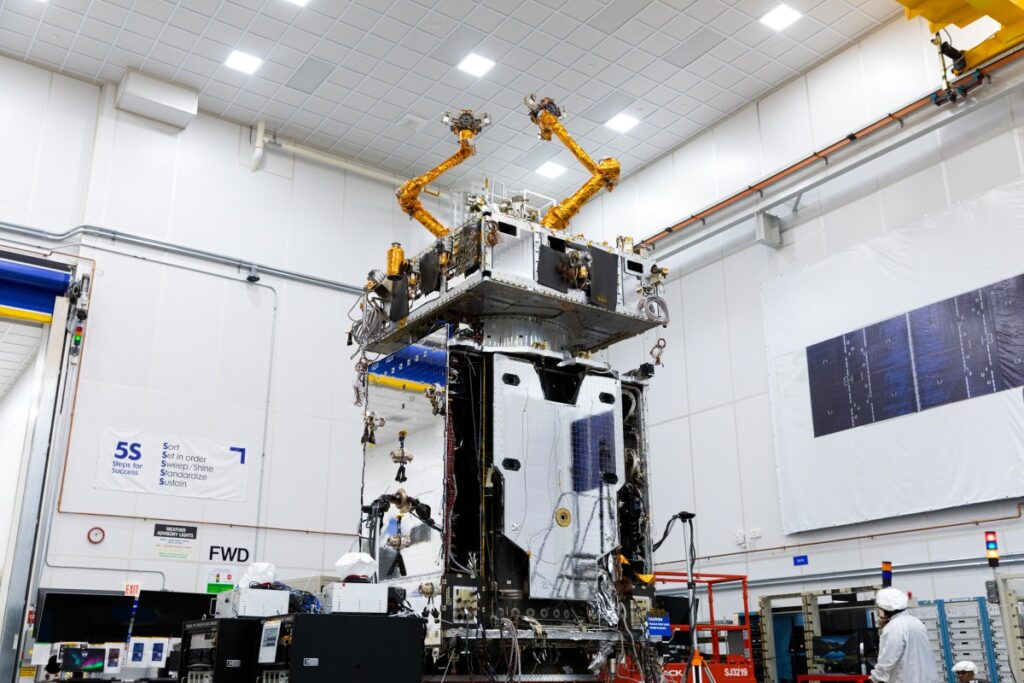
High above the Earth, a new generation of robots designed to keep satellites working longer is replacing its predecessor — quite literally.
This week, a spacecraft built and operated by Northrop Grumman called a Mission Extension Vehicle (MEV) unplugged from a communications satellite operated by the Australian firm Optus. For more than a year, the MEV spacecraft has been stuck to the back of the Optus satellite, keeping it in the right place in space so it can continue its mission.
Here’s an exclusive view from the MEV’s on-board camera, showing the Optus satellite and the Earth behind as the two spacecraft moved apart.
A view of the Optus-D3 satellite and the Earth, taken by Northrop Grumman’s MEV spacecraft.
The satellite life-extension spacecraft is leaving to make room for its replacement. In July, four new Northrop spacecraft launched into orbit on a SpaceX Falcon 9 rocket. One is called the Mission Robotic Vehicle (MRV), a powerful satellite equipped with two advanced robotic arms that was developed by DARPA, the U.S. military research organization. The other three are called Mission Extension Pods, or MEPs, smaller, simpler satellites that are e…
Those four spacecraft are currently headed for targets around 27,000 miles above the Earth. In 2027, the MRV will use its robotic arms to attach one of the MEP pods to the Optus satellite, which should keep it in orbit for years to come.
The satellites that provide communications or scan the planet with various sensors only last for so long. They typically fail when they run out of fuel to stay in the right place, not because their computers and transceivers stop working. The Optus satellite was launched in 2009, and designed for a 15-year lifespan. If all goes well, the satellite could fly — and generate revenue — for another six years.
Now, cheaper launch costs and lower-cost space components are making spacecraft repair missions a reality.
The goal is “a paradigm shift where we can see space as sustainable, with a more resilient architecture and infrastructure base where we can do things like spacecraft repairs, life extension, or even upgrades and maintenance of satellites,” according to Northrop’s director of logistics and servicing, Cassie Wong.
There are two MEVs in orbit right now, launched in 2019 and 2020, which have provided 10 years of life extension to three customers, including two different Intelsat spacecraft and the Optus satellite. MEV-1 will wait in a parking orbit for another customer, while MEV-2 is currently attached to its Intelsat customer until 2030.
The Mission Robotic Vehicle, or MRV, represents an evolution of the business model. Satellite operators buy and own the MEPs, which are permanently attached to their spacecraft. That frees up the MRV to service more vehicles, creating a cheaper offering.
The offering requires some serious technology chops. The vehicles need to autonomously approach one another and dock safely, not a simple task when both are moving at velocities of thousands of miles an hour. The MEVs use a docking probe to plug in and hang onto satellite thruster nozzles. Meanwhile, the MRVs will need to carefully attach the MEPs using their robotic arms.
与大多数卫星不同,MRV 被设计为可以在轨道上加油——部分是为了证明如果这种在轨服务成为常态,其他卫星将需要具备的能力。目前,这种改装的额外成本和重量使航天器运营商不愿投资于此。
Indeed, the current trend in satellites is flying lots of cheap, effectively replaceable spacecraft in low orbits, as Starlink and Amazon LEO do. On the other hand, spacecraft keep getting bigger, and there are plenty of expensive, large satellites in orbit that could benefit from life extension. Wong hopes that the MRV will take on other missions in the future, adding new components to satellites as well as adjusting their orbits.
这很可能包括国防客户,鉴于其在高轨道上拥有大量昂贵的卫星,以及DARPA在开发MRV的机械臂方面的参与。事实上,美国太空军此前曾将中国的一款带有机械臂的在轨服务航天器视为武器,因为理论上它可以捕获并破坏对手的卫星。诺斯罗普表示,其车辆专注于服务任务。
王说,该飞行器也可以用于低地球轨道(LEO),以延长那里有价值的资产的使用寿命。初创公司Katalyst Space正在尝试执行类似的使命,以在发生故障后延长NASA太空望远镜的使用寿命。