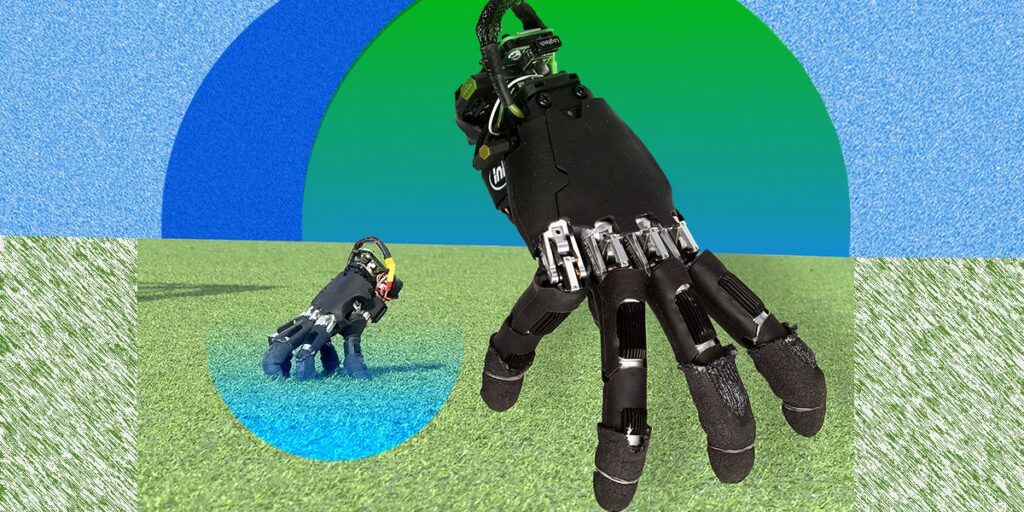
With a little bit of modification and training, an off-the-shelf robot hand can be an entire mobile robot.
A handattached to the end of an arm is a given for most humans, but what if robots didn’t have to play by the same rules as we do? Researchers fromETH Zurichhave turned an off-the-shelf robotic hand intoa completely self-contained robotthat walks on its fingertips while using those same fingers to manipulate its environment.
Besides making the perfect Halloween accessory for anyone planning to dress up as a member of the Addams Family—who were famously accompanied by a disembodied walking handcalled Thing—this robotic hand could make it possible to operate controls and handle objects in places a traditionalrobot armcan’t reach, the researchers say.
Amirhossein Kazemipour, a Ph.D. candidate in theSoft Robotics Lab at ETH Zurichwho led the project, believes this hand could prove useful in contexts like fiddly maintenance tasks in industrial settings, or insearch and rescue, where a robot could detach its hand to explore confined spaces too tight for the rest of its body. More broadly, he says, the work is a step toward a new approach toroboticsin which body parts are not confined to a single …
“I wanted to see how much a robotic hand could do without the rest of the robot,” Kazemipour toldIEEE Spectrum. “Instead of having this traditional view of robotic parts, what if we could use those parts to do other tasks that they are not designed to do?”
This isnot the first attempttoget a robot hand to walk, but previous work has typically relied on specially designed hands. TheETHteam instead decided to use off-the-shelf hardware fromWuji Technology, augmented with an 80-gram backpack containing a battery, an inertial measurement unit (IMU), and aRaspberry PiZero. Kazemipour says they decided to go with a commercialrobot handbecause they didn’t want to compromise on the hand’s manipulation capa…
To teach the hand to walk, the researchers trained a model in simulation using reinforcement learning—an approach in which models learn skills through many rounds of trial and error, receiving rewards for getting closer to the desired behavior along with penalties when they diverge from it. But Kazemipour says the unusual geometry of a hand meant they couldn’t just reuse methods used to train other kinds oflegged robots. Standard quadrupeds or bi…
In addition to rewards for moving at the right speed and in the right direction and penalties for things like wobbling or jerky movement, the team introduced a novel way to keep the hand in a crawling stance during the simulated training. To account for unequal digit length, they gave each finger its own target position relative to the palm, based on where it naturally sits when in the crawling posture. They then penalized the fingers for strayin…
The team also trained separate models for skills like righting the hand when it falls over, pressing keys on a keyboard, and pushing objects to a target. All four models fit on the onboard computer, says Kazemipour, and the controller can switch between them as necessary. In real-world tests, the hand crawled across 14 different surfaces including smooth floors, metal grates, grass, and gravel. Other experiments confirmed that it could make both …
“What interests me most about this work is that the same fingers can move the hand, support its weight, and interact with its surroundings,” saysMasahiko Inami, a professor at the University of Tokyo whose group has developedhand-shaped walking robots. He agrees that a mobile hand could be useful for reaching confined spaces and operating controls that an entire arm could not easily access, though he says practical deployment would require onboar…
However,Matei Ciocarlie, an associate professor of mechanical engineering atColumbia University, says it’s a “cool result” that suggestsrobot handsdon’t have to be restricted to the same capabilities as their human counterparts. “One can imagine an entirely new class ofmobile manipulatorsthat are simultaneously dexterous, able to traverse complex terrain, and able to manipulate payloads comparable in size to themselves,” he says.
Kazemipour sees his work as part of a longer-term vision for robots made up of parts that are not tied to a single job or even a single body plan, something he calls “autonomous modular embodiments.” “Robotic body parts should not be permanently assigned to a single function,” he says. “They can dynamically transition between roles, between being components of one embodiment system and autonomous agents, according to the task.”
Edd Gentis a freelance science and technology writer based in Bengaluru, India. His writing focuses on emerging technologies across computing, engineering, energy and bioscience. He’s on Twitter at@EddytheGentand email at edd dot gent at outlook dot com. His PGP fingerprint is ABB8 6BB3 3E69 C4A7 EC91 611B 5C12 193D 5DFC C01B. His public key ishere.DM for Signal info.
The same fingers serving as legs, supports, and manipulators raises an interesting reliability question: how would the controller recognize that a finger is slipping or becoming overloaded before the hand falls?
Could an uncertainty-aware monitoring layer use joint and motion signals to trigger a safer posture or recovery behavior, especially during transitions from crawling to pressing a key or pushing an object? What experiments would distinguish early warning of failure from simply detecting a fall after it happens?